Join the Fight Against Hunger

Call Us Today
+256 434 132 858
Facts About Hunger and Malnutrition: Global and Uganda
Global Hunger and Malnutrition
Hunger and malnutrition remain among the world’s greatest development challenges, affecting millions of people despite sufficient global food production.
Hunger and Malnutrition in Uganda
Uganda has made progress in agricultural production and nutrition, yet hunger and malnutrition remain significant challenges, especially among vulnerable populations.
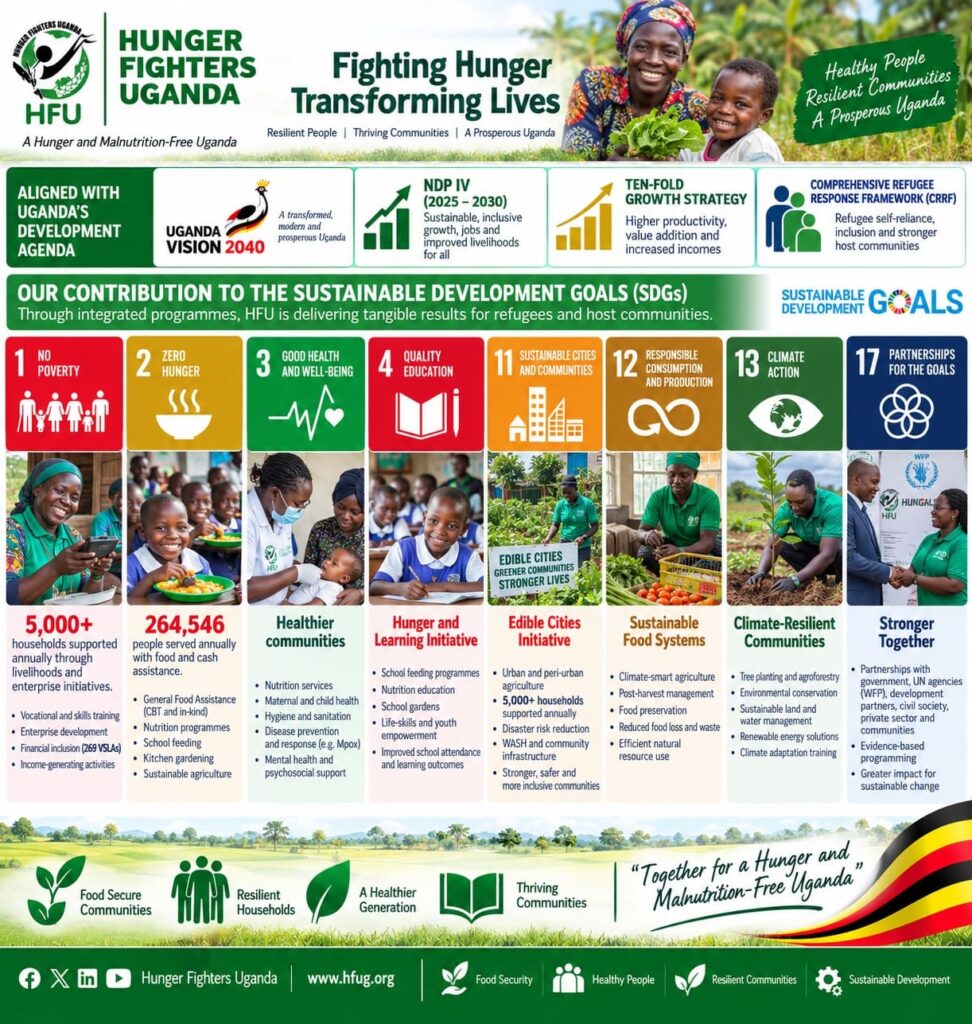
Hunger Fighters Uganda (HFU) aligns its programmes with Uganda’s national development priorities and the United Nations Sustainable Development Goals (SDGs). Through integrated humanitarian, resilience, and development interventions, HFU contributes to inclusive economic growth, food security, climate resilience, and improved livelihoods for refugees and host communities across Uganda.
Supporting Uganda Vision 2040
HFU contributes to Uganda Vision 2040 by investing in human capital development, food and nutrition security, sustainable agriculture, environmental conservation, community resilience, and socioeconomic transformation. By empowering vulnerable households to become self-reliant, HFU supports the country’s long-term aspiration to transform Uganda into a modern and prosperous society.
Contributing to the Fourth National Development Plan (NDP IV)
HFU’s programs complement the objectives of NDP IV by strengthening agro-industrialization, improving household incomes, enhancing nutrition, creating employment opportunities for youth and women, promoting financial inclusion, building resilience to climate change, and supporting local economic development. Through evidence-based programming and community participation, HFU contributes to Uganda’s agenda of sustainable and inclusive growth.
Supporting Uganda’s Ten-Fold Growth Strategy
HFU contributes to the Government of Uganda’s Ten-Fold Growth Strategy by advancing agricultural productivity, enterprise development, value addition, food systems transformation, climate-smart agriculture, financial inclusion, skills development, and community entrepreneurship. Through livelihood diversification and market-oriented interventions, HFU helps households transition from humanitarian assistance to sustainable economic participation.
Advancing the Comprehensive Refugee Response Framework (CRRF)
HFU is committed to Uganda’s Comprehensive Refugee Response Framework (CRRF) by implementing programmes that strengthen refugee self-reliance while promoting peaceful coexistence with host communities. Through food assistance, nutrition services, livelihoods, financial inclusion, climate resilience, protection, and social cohesion initiatives, HFU supports integrated service delivery that benefits both refugees and host populations, in line with Uganda’s progressive refugee policy.
HFU’s Contribution to the Sustainable Development Goals (SDGs)
HFU advances the following Sustainable Development Goals through its programmes:
Our Commitment
HFU remains committed to supporting Uganda’s national development agenda while contributing to global development priorities. By aligning its work with Uganda Vision 2040, NDP IV, the Ten-Fold Growth Strategy, the Comprehensive Refugee Response Framework (CRRF), and the Sustainable Development Goals, HFU is helping to build resilient, food-secure, healthy, and prosperous communities where no one is left behind.